
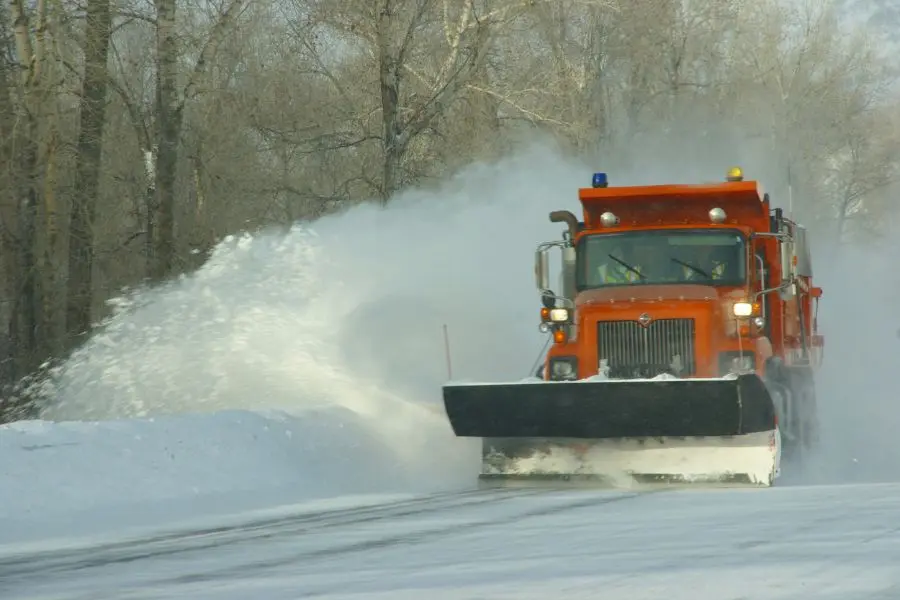
After a snow plow accident in Buffalo, the owner and operator of the plow is usually liable: the City of Buffalo, Erie County, a town, New York State, the Thruway Authority, or a private contractor. If the plow was actually clearing the road at the time, New York law requires proof of reckless disregard, not just ordinary carelessness.
Lake-effect storms put hundreds of plows on Western New York roads at once, from the Skyway and the Kensington Expressway to side streets in South Buffalo, Cheektowaga, and Lackawanna. At Rosenthal, Kooshoian & Lennon, LLP, our Buffalo car accident lawyers treat a plow crash as its own kind of case. The defendant is often a government agency and the deadlines are much shorter than in a typical car accident. The legal standard depends on what the plow was doing when it hit your car, and New York's 2026 changes to car accident law add new fault rules on top.
Call us 24/7 at 716-854-1300 to speak with a personal injury lawyer near you, or contact us for a FREE consultation.
The plow's owner usually answers for the driver's conduct, because an employer is generally responsible for an employee driving on the job. In Erie County, the owner depends on the road: city streets, county roads, town roads, state routes, and the Thruway are each plowed by a different public body, and private lots by contractors.
The rule that holds an employer responsible for an employee's driving is called vicarious liability, and our post on what vicarious liability means in law explains how it works. In a plow case, the driver is rarely the real target of the claim. The city, county, state agency, or contractor that put the truck on the road is the one with the insurance or the public funds to pay.
Figuring out who owned the plow is not always obvious at the scene. A town truck can be plowing a county road under an inter-municipal agreement. A private contractor can be working a state contract. The unit number on the door, the police report, and a few early records requests usually settle it, and that answer controls which court hears the claim and how fast it must be filed.
New York Vehicle and Traffic Law § 1103(b) exempts vehicles "actually engaged in work on a highway" from the ordinary rules of the road. A plow clearing or salting a road at the time of a crash is liable only for reckless disregard for the safety of others, a much higher bar than everyday negligence.
The Court of Appeals, New York's highest court, confirmed this rule in Riley v County of Broome in 2000. In the same decision, the court resolved Wilson v State of New York, a Fourth Department case involving a State snowplow that was clearing snow. The court held that § 1103(b) covers every vehicle actually doing highway work, no matter how the vehicle is classified, and that its operators answer only for reckless conduct.
The reason behind the rule is practical. Plows have to cross center lines, stop suddenly, back up, and push snow across lanes to do their job. The Legislature decided that drivers doing that work should not be judged by the same traffic rules as a commuter. The exemption has limits, though, and it never protects a plow driver from the consequences of truly reckless driving.
Ordinary negligence applies when the plow was not actually working. The Fourth Department held in Arrahim v City of Buffalo in 2017 that § 1103(b) would not apply if a plow driver was merely traveling from one route to another. In that situation, the plow is judged like any other truck on the road.
The Buffalo decision relied on Hofmann v Town of Ashford, a 2009 Fourth Department case from Cattaraugus County. In Hofmann, the plow was driving between assignments rather than plowing, and the court applied the regular negligence standard. A plow heading back to the garage at the end of a shift, going for fuel, or driving a road that is not part of its assigned route may fall outside the protection entirely.
A raised blade does not settle the question by itself. The Fourth Department has said a plow can still be "engaged in work" with the blade up and no salt spreading, for example while it turns around in the middle of its route. In 2022 and again in 2023, the Fourth Department sent plow cases on to trial because the evidence left real doubt about whether the truck was working its route at the moment of the crash. That makes the plow's route assignment, GPS track, and spreader records some of the most important evidence in the case.
The difference between the two standards is often the difference between a claim that can succeed and one that cannot. Under ordinary negligence, a plow driver who runs a red light or makes an illegal turn is treated like any other driver who did the same thing. Under § 1103(b), the same conduct may not be enough.
Reckless disregard means more than a momentary lapse in judgment. New York courts look for a driver who intentionally did something unreasonable while ignoring a known and obvious risk, so great that harm was highly likely. Speed, visibility, warning lights, and what the driver actually knew all matter.
The Court of Appeals described this standard in Saarinen v Kerr in 1994, a police pursuit case, and later applied it to plows in Riley. A plow drifting a few feet over the center line in a whiteout may not meet it. A pattern of choices that ignores obvious danger raises a very different question. Facts that can support a reckless disregard claim include:
No single fact decides the question. Courts weigh the full picture, and that is why early evidence about the truck, the driver's shift, and the conditions matters so much.
Claims against the City of Buffalo, Erie County, a town, or a village usually require a notice of claim within 90 days under General Municipal Law § 50-e. Claims against New York State or the Thruway Authority go to the Court of Claims, which generally requires a claim or notice of intention within 90 days.
After the notice of claim, a lawsuit against a city, county, or town must generally be filed within one year and 90 days of the crash under General Municipal Law § 50-i. The Court of Claims has its own rules under Court of Claims Act § 10, including a two-year outer limit for negligence claims that start with a timely notice of intention. A claim against a private plow contractor follows the standard three-year deadline in CPLR § 214, covered in our post on New York's personal injury statute of limitations.
When a plow crash is fatal, the clock runs differently. The 90-day notice for a wrongful death claim against a municipality generally starts when a representative of the estate is appointed, and the lawsuit must be filed within two years of the death. Our Buffalo wrongful death lawyers handle those estate filings along with the claim itself.
The 90-day notice is the deadline that catches people. Someone still in physical therapy in February may not think about a claim until spring. A court can allow late notice under General Municipal Law § 50-e(5), but that relief is discretionary and never guaranteed. The same rules apply in other claims against the city, as our post on suing the City of Buffalo for a sidewalk fall explains.
The municipality can demand a sworn oral examination of the injured person, called a 50-h hearing, before any lawsuit is filed. After that, the claim proceeds in New York State Supreme Court, usually in Erie County. State and Thruway claims are heard in the Court of Claims, where a judge decides the case without a jury.
The 50-h hearing under General Municipal Law § 50-h is a question-and-answer session with a lawyer for the city, county, or town and a court reporter. Questions cover how the crash happened, the injuries, medical treatment, and work history. What is said there is used later, so preparation matters. If the municipality demands a hearing, the lawsuit generally cannot be filed until the hearing has happened.
The Court of Claims works differently. Claims are filed and served on the Attorney General's office, and a judge alone decides both fault and damages. Court of Claims judges see plow cases regularly, so the claim has to be built on solid evidence about whether the plow was working and how it was driven.
Yes. A private contractor that hits a car while plowing a parking lot, an apartment complex, or a private road can be held responsible under ordinary negligence rules in most cases. The property owner who hired the contractor may also share responsibility, depending on the contract and who controlled the work.
The § 1103(b) exemption applies to work "on a highway," and a store parking lot or private driveway generally is not one. A contractor's plow backing into a parked car at a plaza on Transit Road, or clipping a driver pulling into a space, is usually judged like any other vehicle collision. Contractors working under a public contract on public roads are a closer question, and the answer turns on the specific facts and the contract.
Private contractors also carry commercial auto insurance with their own claim procedures. Getting the contractor's company name, truck number, and insurer at the scene saves weeks of tracking later.
Yes, and under New York's 2026 rules it can decide the whole case. For car accident injury lawsuits filed on or after late May 2026, CPLR § 1411(b) bars any recovery when the injured person is more at fault than the defendants. Someone found 50 percent or less at fault still recovers, reduced by their share.
Before the 2026 state budget, New York used pure comparative fault in every negligence case, and even a driver found mostly at fault could recover a share of their damages. The new rule applies to personal injury cases governed by New York's no-fault law, which includes most crashes between a car and a plow truck. A driver found 20 percent at fault recovers 80 percent of the damages proven. A driver found 51 percent at fault recovers nothing for pain and suffering. The 2026 law also requires juries to decide fault first under Insurance Law § 5104, before considering the injury.
Plow operators and insurers often argue that the other driver should have stayed back. New York agencies advise drivers to keep well behind plows and never pass one on the right, where the wing plow throws snow and may extend into the lane. Following too closely, passing a plow, or driving too fast for the snow will all be raised against an injured driver. Dash camera video, the police diagram, and the damage pattern on both vehicles usually show who was where. A sideswipe along the passenger side of a car tells a different story than a rear-end hit.
The most useful evidence shows what the plow was doing at the moment of impact: GPS tracking data, route assignments, blade and spreader records, dash camera video, and the driver's shift logs. Photos from the scene and 911 call records fill in speed, visibility, lighting, and where each vehicle was.
At the scene, if it is safe, photograph the truck's unit number, which is usually painted on the door or the plow frame. Note whether the blade was down, whether the amber lights were flashing, and whether salt was coming off the back. Those three details often decide whether the reckless disregard rule applies at all.
Public agencies keep records, but not forever. GPS data and video can be overwritten on a schedule, so written preservation demands should go out quickly. Many fleets also keep maintenance records on lights, alarms, and cameras, which matter if equipment failure played a part. Weather data from the National Weather Service office in Buffalo helps show what the driver could and could not see. Under the 2026 fault rules, this evidence carries even more weight, because the fault decision now comes first.
Yes. An injured driver in New York first turns to their own no-fault coverage, which pays up to $50,000 in basic economic loss under Insurance Law § 5102, mainly medical bills and lost wages. That coverage applies regardless of fault, including when a government plow caused the crash, and the 2026 changes did not alter it.
No-fault does not pay for pain and suffering. A claim for those damages against the plow owner requires a "serious injury" as defined in Insurance Law § 5102(d). That includes a fracture, significant disfigurement, a permanent loss of use of a body organ or system, a permanent consequential limitation of a body organ or member, or a significant limitation of a body function or system. The 2026 law removed the category that once covered injuries keeping someone from most daily activities for 90 of the first 180 days. Our guide on who pays for medical bills after a car accident explains how no-fault and health insurance fit together.
No-fault has its own paperwork deadline: written notice to the insurer, generally within 30 days of the crash. Damage to the car itself can be repaired under the owner's collision coverage, and the insurer may then pursue the plow owner. The owner can also bring a property claim directly, subject to the same notice of claim deadlines.
New York law allows recovery for medical expenses and lost earnings beyond no-fault, future medical care, lost earning capacity, pain and suffering, and loss of enjoyment of life, once the serious injury threshold is met and the injured person was not mostly at fault. A spouse may also claim loss of companionship and household help.
The value of a claim depends on factors that can be documented: the type and permanence of the injury, the treatment needed, time missed from work, and how daily life has changed. A torn rotator cuff in a 45-year-old electrician affects work in ways that a doctor, an employer, and sometimes an economist can explain. Life care planners help put a figure on long-term needs when injuries are permanent.
The 2026 law also caps non-economic damages at $100,000 when the injured person was driving uninsured, or was convicted of impaired driving or of a felony committed during the crash, unless the crash caused a death. Plow trucks are heavy, and a broadside or rear impact from one can cause injuries well beyond a typical crash: spinal fractures, traumatic brain injuries, and crushed vehicle cabins. Those cases call for early medical documentation and a careful record of how the injury progresses.
The same liability rules apply. A plow that strikes a parked car, a pedestrian on a snowy street, or a car carrying passengers is judged under § 1103(b) if it was working its route, and under ordinary negligence if it was not. Passengers and pedestrians have no-fault rights in New York too.
Parked car claims are usually property claims, and they still need a notice of claim when a municipal plow is involved. Ice chunks and packed snow thrown from a wing plow through a windshield raise similar questions about how the plow was being operated. Pedestrians are especially exposed when sidewalks are buried and people walk in the street. Our Buffalo pedestrian accident lawyers handle those cases.
Call 911, get medical care, and photograph the plow, its unit number, the road, and the damage before the scene changes. If anyone was hurt or damage to any one person's property exceeds $1,000, file an MV-104 with the DMV within 10 days under Vehicle and Traffic Law § 605.
Avoid arguing with the plow driver or guessing about fault at the scene, and keep fault statements off the MV-104 unless they are facts you saw. Get the names of any witnesses, including other drivers stuck behind the plow, because their account of its speed and position can be decisive. Ask the responding officer which agency owns the truck, and write down the answer. Our post on the steps to take after a car crash covers the rest of the first week.
Count 90 days from the crash date and put that date on the calendar right away. That one deadline protects more plow claims than anything else.
Our Buffalo car accident attorneys start by identifying who owned the plow and which deadline applies, then send preservation demands for GPS data, video, and route records. The work then moves to the notice of claim, the evidence on fault and on whether the plow was actually working, and the injury proof New York law requires.
These cases stay in house from the first call through the notice of claim, the 50-h hearing, a suit in New York State Supreme Court or a claim in the Court of Claims, and trial if needed. Accident reconstructionists, treating doctors, and weather records help show what happened in the seconds before impact and how the injuries have changed daily life. Under the 2026 rules, the fault fight starts on day one, and insurance adjusters and municipal attorneys see that preparation from the start.
A crash with a city, county, state, or contractor plow comes with its own legal standard, new 2026 fault rules, and some of the shortest deadlines in New York injury law. Rosenthal, Kooshoian & Lennon, LLP can review what happened, identify the plow owner, and explain what New York law allows for your injuries and your car.
Call us 24/7 at 716-854-1300 to speak with a personal injury lawyer near you, or contact us for a FREE consultation.
Sources
Our results are driven by personalized strategies that are hand-crafted to fit your needs.
You’re not just a client to us. You are our partner, and we would be honored to make you our next success story.
As former prosecutors and experienced attorneys, we can anticipate how your case will be handled by the other side and tactics insurance companies will use.