
In a black ice accident, the driver who lost control is usually at fault, because New York law expects drivers to slow down and leave room when roads may be icy. In a Buffalo winter, black ice is rarely an excuse. A city, the State, or a property owner can share fault when they created or ignored the ice.
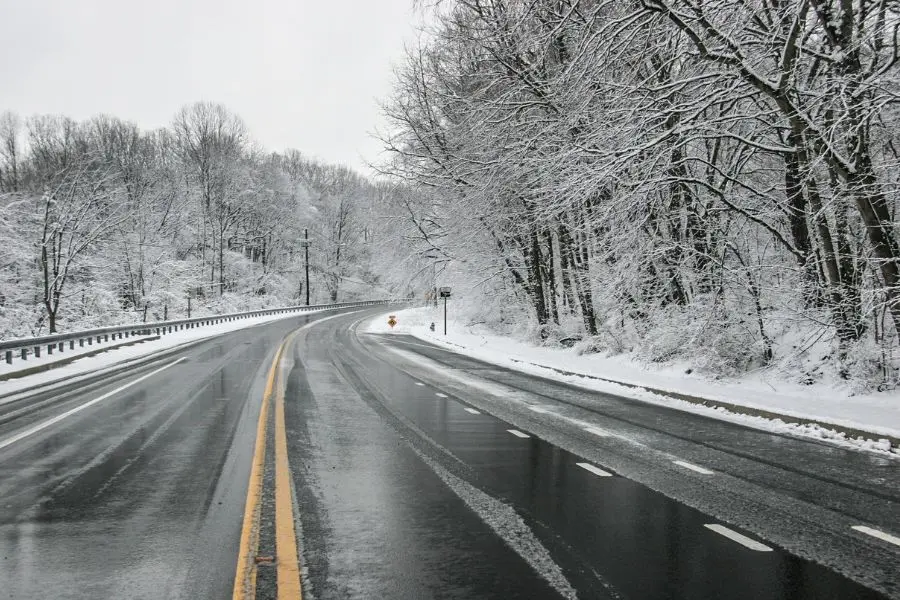
Black ice is a thin, clear layer of ice that looks like wet pavement. It forms on bridges, overpasses, shaded curves, and low spots when temperatures hover near freezing, and Western New York sees plenty of it from November through March. At Rosenthal, Kooshoian & Lennon, LLP, our Buffalo car accident lawyers represent people hurt when another driver slid through an intersection, crossed the center line, or rear-ended them on ice. The question of fault decides whether a claim succeeds, and New York's 2026 changes to car accident law make that question even more important.
Call us 24/7 at 716-854-1300 to speak with a personal injury lawyer near you, or contact us for a FREE consultation.
Not automatically, but usually. New York Vehicle and Traffic Law § 1180 requires drivers to keep a speed that is reasonable for actual and potential hazards, and to slow down when weather or road conditions create special hazards. A driver who slides on ice is generally treated as having failed to adjust.
Insurance adjusters and juries start from a simple idea: in a place like Buffalo, ice in winter is foreseeable. A driver who knows it has been snowing, freezing, or thawing all day is expected to slow down, brake earlier, and leave extra distance. When that driver slides through a stop sign on Elmwood Avenue or across the center line on Route 20 in Orchard Park, the slide itself is strong evidence the driver was going too fast for the conditions.
Fault is still decided on the facts. A driver who was creeping along at 10 miles per hour on a road that showed no sign of ice, and hit a single isolated patch, is in a different position than a driver doing 55 on the Thruway during a lake-effect band. The details of speed, weather, warnings, and road conditions all matter.
Usually not. New York's emergency doctrine can excuse a driver who faced a sudden, unexpected situation not of their own making. In Caristo v Sanzone in 2001, the Court of Appeals held that ice on a road could not be a sudden emergency for a driver who knew about the worsening weather.
In Caristo, the driver had been aware of deteriorating winter weather for some time before his car slid down a hill, past a stop sign, and into another vehicle. The Court of Appeals held the jury should not have been told he faced an emergency. Anyone driving through those conditions with reasonable care should expect ice. New York courts have applied that reasoning in many winter crash cases since.
There are narrow exceptions. Some courts have allowed an emergency defense when a driver hit a truly isolated patch of ice after hours of dry, clear driving, with no warning signs at all. Those cases are rare in a region where lake-effect snow can arrive in minutes, and the driver claiming the emergency has to show the ice was genuinely unexpected.
The rear driver is almost always at fault. Under New York law, a rear-end collision with a stopped or slowing vehicle creates a presumption that the rear driver was negligent. Ice on the road does not usually rebut that presumption, because drivers must keep a safe following distance under VTL § 1129.
Rear-end crashes are the most common winter collisions in Erie County, especially at backed-up intersections on Transit Road, Niagara Falls Boulevard, and Union Road. A driver who says "I hit the brakes and just kept sliding" is usually describing following too closely or driving too fast for the ice. To avoid fault, the rear driver generally has to give a non-negligent explanation, such as being pushed by another car from behind.
Chain-reaction crashes add a layer. When a third car slams into the second and pushes it into the first, the third driver may carry most of the fault. Our Buffalo rear-end accident lawyers handle these multi-car claims, where the order of impacts often decides who pays.
Then the case turns on the details. Fault can be shared, and in some cases neither driver may be found negligent. Speed, following distance, tire condition, braking, steering, and what each driver could see all matter. Witnesses, vehicle data, and the damage pattern usually show what each driver did in the seconds before impact.
New York looks at fault in percentages. A jury might find one driver 70 percent at fault for speeding on ice and the other 30 percent at fault for pulling out without enough room. Under the rules that took effect in 2026, those percentages carry more weight than ever in car accident injury cases, as explained below.
Many newer vehicles record speed, braking, and steering in the seconds before a crash on an event data recorder, sometimes called a black box. Dash camera video, intersection cameras, and nearby business cameras can also show speed and spacing. That evidence often answers the question of whether a driver was really being careful.
For car accident injury lawsuits filed on or after late May 2026, CPLR § 1411(b) bars any recovery when the injured person is more at fault than the defendants. Someone found 50 percent or less at fault still recovers, reduced by their share. Juries now decide fault before deciding whether the injury qualifies.
Before the 2026 state budget, New York used pure comparative fault in every negligence case. A driver found 70 percent at fault for a crash on ice could still recover 30 percent of their damages. Now, in personal injury cases governed by New York's no-fault law, a driver more than half at fault recovers nothing for pain and suffering. A driver found 20 percent at fault for not slowing down enough still recovers 80 percent.
That shift raises the stakes on every winter crash. Insurers will argue that an injured driver was also going too fast for the ice, and that argument can now decide the whole case rather than reduce it. Early evidence of speed, spacing, and road conditions matters more than ever.
Sometimes, but it is difficult. Public entities have a duty to keep roads reasonably safe, but many have prior written notice laws for snow and ice. The City of Buffalo's Charter, § 21-2, bars claims based on snow or ice on a street unless written notice was given to the City Clerk beforehand.
Prior written notice laws mean that a phone call, a 311 report, or general knowledge that a road gets icy is usually not enough. The Fourth Department, which hears appeals from Erie County, applies these rules strictly. There are exceptions. A municipality can be liable without prior written notice if it created the dangerous condition through an affirmative act, such as a drainage design that sends water across a road to freeze, or a negligent repair. Simply failing to salt or plow is generally treated as not acting, which does not fit that exception.
Claims against New York State, which maintains state routes such as the Kensington Expressway and the Skyway, go to the Court of Claims. Thruway claims also go there. The State does not use the same prior written notice rule, but a claimant generally must show the State knew or should have known of a recurring icy condition, such as a known drainage problem, and failed to address it reasonably. These claims have short deadlines, covered below.
Yes, in some cases. A store, plaza, apartment complex, or office park that lets meltwater refreeze across a driveway, or that piles plowed snow where runoff turns to ice, may share fault for a crash or a fall on its property. Liability depends on notice, timing, and what the owner did or failed to do.
Property owners in New York generally get a reasonable time after a storm ends to clear snow and ice, under what is called the storm in progress rule. Ice that forms days later from a leaking gutter, a clogged drain, or a snowbank melting across a lot is a different situation. These claims often involve pedestrians who fall rather than drivers who slide. Our post on what to do after you slip and fall on ice in Buffalo covers that side.
Commercial drivers face specific federal rules. Under 49 CFR § 392.14, interstate truck and bus drivers must use extreme caution in hazardous conditions such as snow and ice, reduce speed, and stop driving if conditions become too dangerous. A truck that jackknifes on an icy Thruway may point to a violation of that rule.
Large trucks need far more distance to stop, and on ice that distance grows dramatically. Trucking companies also set schedules and may pressure drivers to keep moving through storms. Driver logs, dispatch records, and electronic logging device data can show whether the driver and the company ignored conditions. Our Buffalo trucking accident lawyers handle these claims, where federal and state rules apply together.
Insurers and juries look at speed compared with conditions, following distance, how long the bad weather had been going on, whether warnings or travel advisories were in effect, the condition of the tires and brakes, and whether a driver was distracted. Each fact either supports or undercuts the claim that the ice was unavoidable.
Erie County drivers sometimes face driving bans during major storms, as in the December 2022 blizzard. A driver who was on the road in violation of a ban will face hard questions about fault. A driver who was required to be at work, such as a nurse heading to a hospital shift, may be in a different position, depending on the terms of the ban.
Photos of the road surface, the vehicles, and where they came to rest are the most useful evidence, along with weather records, police reports, witness names, dash camera video, and vehicle data. Ice can melt within hours, so documenting the surface at the scene can be decisive.
If it is safe, photograph the road, including shaded areas, bridge decks, and any water running across the pavement. Note the time, the temperature on the dashboard, and whether salt or sand had been put down. Ask the responding officer whether other cars slid at the same spot, because a cluster of crashes can show the conditions were obvious, or that a public entity knew about a recurring problem.
Weather records from the National Weather Service office in Buffalo show when precipitation started and how long temperatures stayed below freezing. Those records often undercut a claim that the ice came as a surprise. Our post on the most common fall driving hazards covers the early-season conditions that catch many drivers off guard.
No-fault coverage pays up to $50,000 in basic economic loss under Insurance Law § 5102, mainly medical bills and lost wages, regardless of who caused the crash. A claim for pain and suffering against the at-fault driver requires a "serious injury" and, after the 2026 changes, that the injured person was not mostly at fault.
Serious injury under Insurance Law § 5102(d) includes a fracture, significant disfigurement, a permanent loss of use of a body organ or system, a permanent consequential limitation of a body organ or member, or a significant limitation of a body function or system. The 2026 law removed the category that once covered injuries keeping someone from most daily activities for 90 of the first 180 days. The 2026 law also caps non-economic damages at $100,000 when the injured person was driving uninsured, or was convicted of impaired driving or of a felony committed during the crash, unless the crash caused a death.
Written notice to the no-fault insurer is generally due within 30 days of the crash. Damage to the car itself is handled through collision coverage or a property claim against the at-fault driver. Property damage claims still follow the older rule, where fault reduces the recovery but does not bar it.
Most car accident injury lawsuits in New York must be filed within three years under CPLR § 214(5). Claims against a city, county, or town usually require a notice of claim within 90 days, and claims against the State or Thruway Authority generally require a claim or notice of intention within 90 days in the Court of Claims.
Those 90-day deadlines are where many winter claims are lost. A driver who is still recovering in February may not think about a road-condition claim until spring. Our post on New York's personal injury statute of limitations explains the general rules, and our post on suing the City of Buffalo for a sidewalk fall covers how notice-of-claim rules work against the city.
If anyone was hurt, or damage to any one person's property exceeds $1,000, each driver must also file an MV-104 report with the DMV within 10 days under VTL § 605. What a driver writes on that form about the ice and their speed can come up later in the fault fight.
Our Buffalo car accident attorneys start by locking down the evidence of speed, spacing, and road conditions: photos, vehicle data, weather records, and witness statements. Then they identify every party who may share fault, check public-entity deadlines, and build the injury proof New York law requires.
Under the 2026 fault rules, the fight over who caused the crash starts on day one, and insurers know a black ice defense rarely holds up when the weather was foreseeable. Accident reconstructionists, treating doctors, and economists help show how the crash happened and what it has cost. Every case is handled in house, from the first call through trial in New York State Supreme Court or the Court of Claims. Our guide to the steps to take after a car crash covers the first week after any collision.
A crash on black ice happens in a second, and the driver who slid into you may insist nobody could have stopped. New York law usually sees it differently. Rosenthal, Kooshoian & Lennon, LLP can review the evidence, identify who is responsible, and explain what New York law allows for your injuries and your car.
Call us 24/7 at 716-854-1300 to speak with a personal injury lawyer near you, or contact us for a FREE consultation.
Sources
Our results are driven by personalized strategies that are hand-crafted to fit your needs.
You’re not just a client to us. You are our partner, and we would be honored to make you our next success story.
As former prosecutors and experienced attorneys, we can anticipate how your case will be handled by the other side and tactics insurance companies will use.